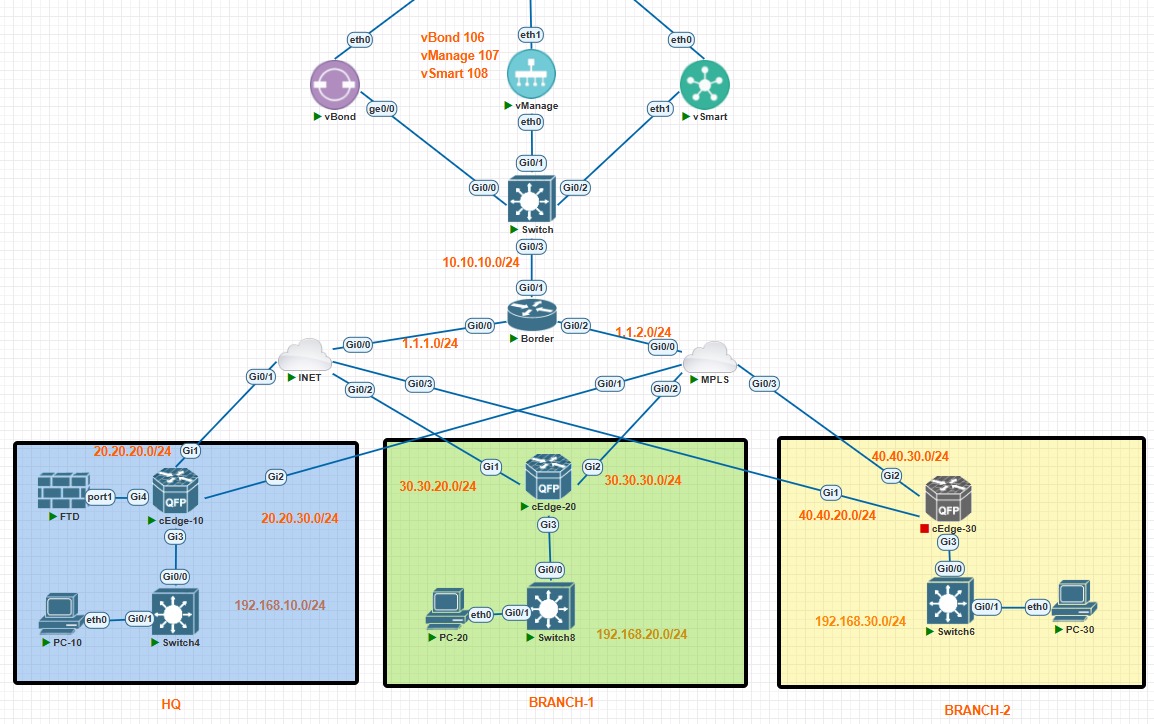
Modernizing WAN architecture with Cisco SD-WAN
The goal of this project was to move away from rigid, expensive MPLS-only dependencies and transition to a flexible, software-defined WAN that leverages both private and public transport. The objective was to connect HQ with two remote branches (BR1 & BR2) using a cloud-first orchestration model. By decoupling the control plane, we achieved a consistent, secure, and resilient network fabric managed from a single pane of glass.
// Cloud-first control plane & ZTP
Utilized cloud-hosted controllers (vManage, vBond, vSmart) allowing edge devices to securely orchestrate over the public internet upon boot, simplifying zero-touch provisioning.
// Transport independence & load balancing
Configured WAN links agnostically by tagging MPLS as private and Internet as public-internet, enabling active-active load balancing rather than leaving backup links idle.
// Segmentation via VPNs
Implemented strict VRF segmentation, reserving VPN 0 for the transport underlay and isolating user traffic across HQ and branches inside service-side VPN 10.
// Automated routing with OMP
Replaced legacy routing with Overlay Management Protocol (OMP) to automatically distribute and propagate subnet routing without manual site-by-site configurations.
// Policy-driven traffic steering
Applied application-aware Centralized Data Policies to dynamically steer critical traffic, triggering sub-second failover from MPLS to Internet if jitter or packet loss exceeds 1%.